
Category Archives: Devotional

The Silence of Friends

“In the End, we will remember not the words of our enemies, but the silence of our friends.”          

 – Martin Luther King Jr. (1929-1968)

For some time, I was quite reluctant to join an online social network.  Although the invites came, I continued to decline them for various reasons including, but not limited to, the fear of privacy invasion.  Then one day, much to my surprise, I felt a stirring in my heart; I felt I should sign-up  and begin to connect with the friends and family that had gradually slipped out of my life. So I joined.

Truthfully, there are at least a dozen things I dislike about  social networks, but I’m not here today to complain about those. Rather, I want to share with you what I most appreciate about them; which is the opportunity to share in the lives of others.

You see, I have discovered that most people join  social networks in order to  have a “voice.”  In today’s world, cold and impersonal, many folks are simply looking for an opportunity to share the details of their lives, and to know someone cares enough to listen.  I find too, that in the non face-to-face environment of the internet, many folks are less reluctant to share with others their triumphs and their tragedies –to freely share their feelings of  sadness, fear and frustration, as well as their joy.

What better opportunity for us to fulfill the biblical precept to Rejoice with them that do rejoice, and weep with them that weep (Romans 12:15).

Yes, I am thankful for the opportunity to pray for those in need, or to speak a word of encouragement to those who are down, even if I have never met them in person.  I know there will certainly be times that I will fail my friends. But as often as I am able, I truly desire to let my friends know that I do care about the details of their lives. And I pray that in the end, it will not be my silence that they remember.

The Biggest Little Word

What is the biggest word in the Bible?

The answer may surprise you. The biggest word in the Bible is “IF.” You may ask how I could come to that conclusion? Simple, it is because this tiny word carries enough power in it to move mountains. Even so, this word is probably one of the most overlooked and neglected words in the entire Bible.

For example, notice the first word of II Chronicles 7:14:

If my people, which are called by my name, shall humble themselves, and pray, and seek my face, and turn from their wicked ways; then will I hear from heaven, and will forgive their sin, and will heal their land.

Is it possible that there is so much turmoil in our land because we are asking God to heal our land but neglect the “if” part –to humble ourselves, and pray, and  seek God’s face, and  turn from our wicked ways?

God is not a man that He should lie, so obviously, we as a nation are neglecting the prerequisites that God set forth for the healing of our land.

Another example may be found in the twenty-eighth chapter of Deuteronomy. Here, we are instructed:

And it shall come to pass, if you shall listen diligently to the voice of the LORD your God, to observe and to do all his commandments which I command you this day, that the LORD your God will set you on high above all nations of the earth.

Scripture then goes on to promise abundant blessing and prosperity to those who obey all of God’s commandments. I hear much about the blessings, but  seldom do I hear anyone mention the prerequisite “IF.”

The Bible says that God uses the foolish thing of this earth to confound the wise. I guess he uses the smallest things too. Remember, dear reader, the word “if” has enough power in it to move mountains, when we obey the words that “if” preceeds.

One Fainting Robin

If I can stop one Heart from breaking
I shall not live in vain;
If I can ease one life the aching,
Or cool one pain,
Or help one fainting robin
Into his nest again,
I shall not live in vain.

Emily Dickinson (1830-1886)

If we were to summarize Miss Dickinson’s aforementioned thoughts in one word, it would aptly be compassion.  But what does Scripture teach us about compassion?

Put on therefore, as the elect of God, holy and beloved, bowels of mercies, kindness, humbleness of mind, meekness, longsuffering… (Colossians 3:12).

 Interestingly,  Emily Dickinson was not an overtly religious person. In fact, her writings often reflect her feelings of “being shut out of heaven.” Nevertheless, she understood the importance of compassion; possibly because she was shown very little during her reclusive life.

 Emily was, I believe, the fainting robin she wrote about.  If only she could have grasped the truth that God is … full of compassion, and gracious, longsuffering, and plenteous in mercy and truth (Psalm 86:15) even towards her .  And if only others had shown her more mercy, love and compassion, as we are commanded to do in Scripture; perhaps she might have lived a more joyous life, having never felt shut out of heaven.

Dear reader, there are many Emily’s out there.  Will you be the one to show them God’s unceasing compassion by loving as Jesus loved?  Will you help a “fainting robin” back into the nest, or stop someone’s  heart from breaking? If you  do this for even one person, then your life will not have been lived in vain.

Bumps and Spills


He was a tall man, so I couldn’t see the contents of the cup he was holding.  I assumed it was coffee, but I was wrong.  You see, as quickly as his bouncy sidekick bumped into him, orange juice sloshed all over his expensive white dress shirt. No one would have ever known what was in his cup if he hadn’t been bumped.

That made me think; human beings are all “vessels” (Romans 9:21). However, we do not all contain the same thing.  Sometimes, the best way to know  for sure what is inside a person, is to see what spills out when he or she is bumped.

O generation of vipers, how can ye, being evil, speak good things? for out of the abundance of the heart the mouth speaketh. A good man out of the good treasure of the heart bringeth forth good things: and an evil man out of the evil treasure bringeth forth evil things (Matthew 12:34,35).

Dear reader, has someone bumped you lately? And if so, what spilled out? As for me I, like King David, pray:

Let the words of my mouth, and the meditation of my heart, be acceptable in your sight, O LORD, my strength, and my redeemer (Psalm 19:14).

Who’s Holding the Scalpel?

Never does the human soul appear so strong and noble as when it forgoes revenge and dares to forgive injury.”   Edwin Hubbel Chapin. 

Forgiveness is a topic I could spend hours writing about, but I want to focus on just one thought for today.  Namely, who is really behind your pain?  By way of explanation, I will ask you the same question I have often posed to others:

If, during a routine surgery, the surgeon were to carelessly slash your face with his scalpel, would you blame the scalpel  for your  injury, or the surgeon holding it?  Even if you were scarred for life, would it be the scalpel’s fault? Or, would the blame lie with the one who was in control of it?

I submit, dear reader, that when others cut you deeply enough to leave an emotional scar, they are generally acting as unsuspecting instruments  in the hands of a very clever adversary –that evil, supernatural enemy which wages war against humanity.  I am certainly not negating the actions of those who hurt you; they are certainly responsible for whatever harm they have done and will be held accountable. But forgiveness is more for your sake than theirs, and it is far more easily accomplished when you truly understand the words of Ephesians 6:12:

For we wrestle not against flesh and blood, but against principalities, against powers, against the rulers of the darkness of this world, against spiritual wickedness in high places.

Simply put, these dark powers are your true enemy, not other people. So the next time you are cut to the quick, dear reader, please remember that just as a scalpel is only a tool in the surgeon’s hands,  the person who hurt you was only a tool in the enemy’s hands. Then, in obedience to Scripture, forgive the offense:

Bear with each other and forgive one another if any of you has a grievance against someone. Forgive as the Lord forgave you (Colossians 3:13).

After all, forgiveness is also an instrument; it is an instrument of healing in the hands of the Great Physician –healing for both you, and  the one who hurt you.

A Canardly

A few years ago we adopted our outdoor dog from a rescue shelter.  She’s a mixed-breed, but I was fairly certain of what those breeds were, based on her color and markings. Still, I asked our veterinarian for his opinion. He told me she was a Canardly.  I’ve never heard of such a creature, I told him.  “There’s really no way to tell what she is,” he explained. With these mixed breeds, one  can ‘ardly tell.” I thought that little play on words was cute, and I’ve used it ever since.

Our beautiful Canardly has turned out to be the most loving and loyal dog of all. Plus, she is an incredibly vigilant watchdog.  Obviously, being a Canardly isn’t such a bad thing for a dog.  I don’t recommend it for Christians, though. How can we teach others about Jesus if they can ‘ardly tell that He is the Lord of our lives?

Jesus warned: I know your deeds, that you are neither cold nor hot. I wish you were either one or the other! So, because you are lukewarm–neither hot nor cold–I am about to spit you out of my mouth (Revelation 3:15,16).

I don’t know about you, dear reader, but I would rather someone be frustrated by my fervor than confused by my complacency.  After all, if I’m not passionate about my Lord, Jesus Christ, how can I expect others to be?

Today, I leave you with this thought from Charles Spurgeon:

Believe me, brothers and sisters, if you never have sleepless hours, if you never have weeping eyes, if your hearts never swell as if they would burst, you need not anticipate that you will be called zealous; you do not know the beginning of true zeal, for the foundation of Christian zeal lies in the heart. The heart must be heavy with grief and yet must beat high with holy ardour; the heart must be vehement in desire, panting continually for God’s glory, or else we shall never attain to anything like the zeal which God would have us know.

God’s “To Do” List

Today I plan to start a new “to do” list. First order of business, find and compile all the other “to do” lists I have lying around, so that I can marvel at how many things I never seem to complete, and hopefully tackle some of them. Of course, the really important things get done, but I have a ton of worthwhile projects that, for one reason or another, got lost in the shuffle, never to be picked up again.

Aren’t you glad that God is not like that? I know I am. Can you just imagine Him starting something wonderful in your life, but stopping somewhere in the middle because He needed to go intervene in some crisis? Worse yet, imagine Him never completing the work?

That won’t happen, of course. Scripture says that He [the Holy Spirit] which hath begun a good work in you will perform it until the day of Jesus Christ (Philippians 1:6). God is working in the lives of every person on this planet, whether they acknowledge  Him or not; and He will never stop until His glorious return.

I guess you could say that we are all on God’s “to do” list since He is never finished with any of us. We should ask ourselves, then, is God at the top of our list? Last night I was challenged by a preacher who admonished his listeners to develop a personal spiritual growth program and pursue it vigorously. He wasn’t insinuating that his audience was neglecting the things of God, only that we should all strive to give even more of our time and effort to the Lord and His word. If we would do that, he encouraged, we would certainly grow spiritually.

I don’t know about you, dear reader, but that sounds like an excellent idea. If God loves me enough to keep me on His daily “to do” list, I think it only right that He is at the very top of mine! On second thought, forget all the old lists, if those projects haven’t been finished by now, they probably aren’t that important after all. Yes, I still plan to start a new list, but the very first item on the list will be: Start a spiritual growth program, beginning with …

In fact, I’m going to go do that now so I’ll catch you all later.
God bless.

Still, Small Voice

And he came thither unto a cave, and lodged there; and, behold, the word of the LORD came to him…. but the LORD was not in the wind: and after the wind an earthquake; but the LORD was not in the earthquake: And after the earthquake a fire; but the LORD was not in the fire: and after the fire a still small voice. (I Kings 19:9,12).

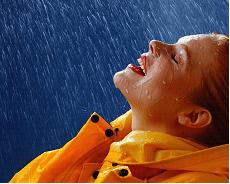
Finally, we have gotten some much needed rain. I’ve been praying for a gully-washer, but the rains that have come have been, for the most part, soft and gentle.

It is often the same way with God. There have been times that I prayed, feeling the need for God’s voice to be as loud and clear as a piercing boom of thunder. I wanted Him to pour down answers until they utterly saturated me, so I could in no way misunderstand what He was speaking to my heart. And yet, the answers sometimes came like more like a soft, refreshing rain –a few drops at a time, not overwhelming. I am reminded of something the Lord spoke to my heart several years ago. He said:

Sometimes I come like the softest rain, when the drops tap ever so lightly against the pane. These are they that please my heart: Those who hear my lightest tap –even in times when the sun is not shining brightly –even in the early morning hours when the world lay fast asleep. Those who will awaken to my lightest tap and say, enter Lord, I welcome you; these are they that please my heart.”

Today feels like one of those days. Precious Lord, let us hear your voice; we welcome you.

How Dumb Are We?

A pastor once instructed his congregation to come forward so he could “pray for their tongue’s foot-by-foot  —honestly. Ouch! I didn’t know any of those folks but I’m sure they would’ve needed some help to hold their tongues.

Come to think of it, I think most of us could use some help in that area; I know I could. Let’s be honest. Sometimes it is hard to keep silent when more and more people are lacking intelligence or good judgment  —which is one definition for the word dumb— and we are the ones to suffer for it.

However, God’s word instructs us that it is often wise to be dumb  —dumb as in not speaking. Proverbs 21:3 says: He who guards his mouth and his tongue keeps himself from calamity. So, the question for today is, how dumb are we? I don’t know about you, but I pray that someday I can be the kind of person who always curbs my tongue.

There is reward in that. Those who refrain their tongue from evil, Scripture instructs, will love life and see good days (I Peter 3:10). It really would be dumb of us to let our tongues go loose until the pastor has to pray for it foot-by-foot. Let us instead, obey Scripture and bridle our tongues. Now that would be smart!

O God of Earth and Altar

We live in one of the greatest countries on Earth, but let us not live in denial: America is a mess!  There are numerous Scriptures to address this concern, but for today, I simply want to share a very insightful hymn by Gilbert Keith Chesterton (1906).

 O God of earth and altar,
bow down and hear our cry,
our earthly rulers falter,
our people drift and die;
the walls of gold entomb us,
the swords of scorn divide,
take not thy thunder from us,
but take away our pride.

From all that terror teaches,
from lies of tongue and pen,
from all the easy speeches
that comfort cruel men,
from sale and profanation
of honor, and the sword,
from sleep and from damnation,
deliver us, good Lord! …